The Parish Church Interior

The interior of St James' is bright, cherished and cared-for, where the absence of stained-glass admits plenty of light to illuminate a variety of craftsmanship from many periods.
A 14th Century ARCADE of four bays divides the south aisle from the nave, although the western bay is wider and taller than the others, and may have been altered later, and Tudor brick has been revealed in its western respond. The SCALLOP SHELL above (the pilgrim emblem of St James) was bought thanks to a donation from his cathedral and shrine at Santiago de Compostela in Spain.
The wooden SCREEN-WORK at the entrance to the nearby vestry dates from the early 1300s and is thought to incorporate parts of a former rood or parclose screen. The former altar of St John's Chapel now serves as the vestry table.
On the nave's west wall, above the tower arch, hang the ROYAL ARMS of King George III. The two ROUND APERTURES flanking them in the wall are one of the church's mysteries. Some have suggested that they may even be blocked Saxon openings in use before the tower was built.A glance at the west window of the tower shows the great thickness of the tower walls. In the belfry above hang the church's four BELLS- their details are as follows:-
- Treble bell (diameter 25", weight 3½ cwt) was recast in 1882 by Moore, Holmes & McKenzie of Redenhall. These Norfolk bell-founders worked from 1875-82 at Harleston (in the parish of Redenhall), using a former ironworks in the town, with the actual founding taking place in Wilderness Lane on its outskirts.
- 2nd bell (diameter 25 3/8", weight 3¾ cwt) was cast by Thomas Newman of Norwich in 1707 and is inscribed with the name of church warden Joseph Barber.
- 3rd bell (diameter 26½", weight 4¼ cwt). This bell is inscribed 'JOHANNES: BROVN : 11B : FECIT ; PIERI' (John Brown caused me to be made) is believed by experts to have been cast by an unknown Norwich founder in the 1300s.
- Tenor bell (diameter 30 5/8", weight 6 cwt) was cast by John Brend I" in 1581 at his Norwich bell-foundry.
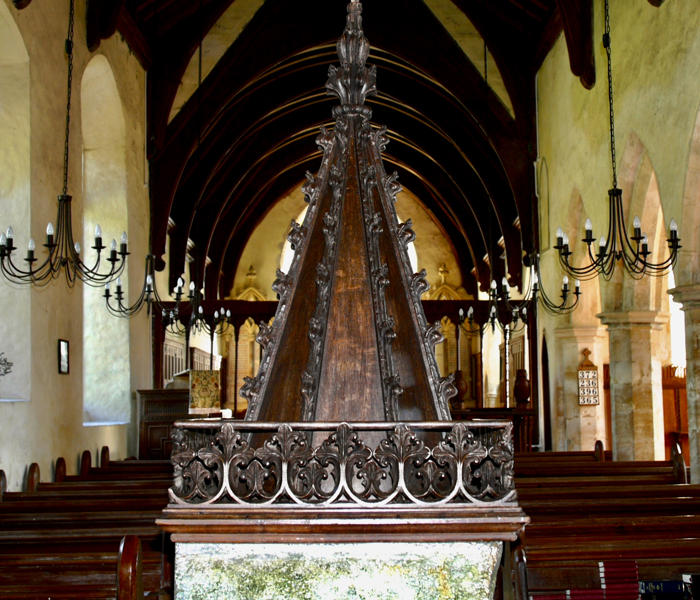
St James' babes have been baptised in its FONT for over 900 years - and still are. It stands at the west end, near the entrance, to symbolise our entry, through Baptism, into the family of the Church. Its massive bowl, of Purbeck marble, has worn shallow arcading and stands upon a circular stem, with four circular shafts at the comers. It is crowned by a beautiful 15th Century FONT COVER- one of only 12 or so medieval examples in Suffolk. It has an elegant crocketted spire, rising from delicate cresting around the base.
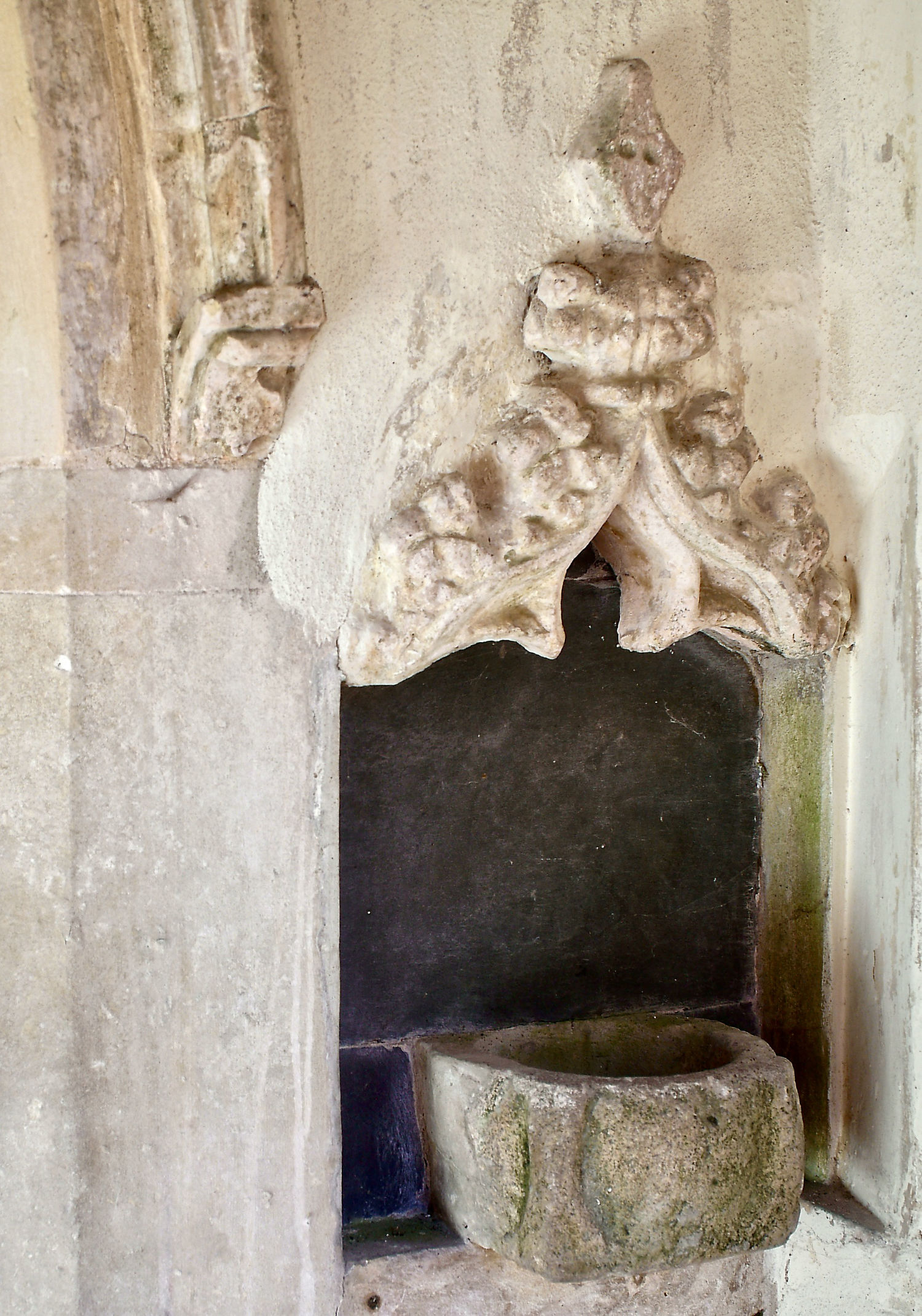
In the wall to the north of the tower arch is a carved stone CORBEL with a tiny flower on its underside. Originally it would have supported a statue, but it now supports a mysterious bird, which some have suggested may have been part of the counterbalance in the mechanism for raising the font cover.
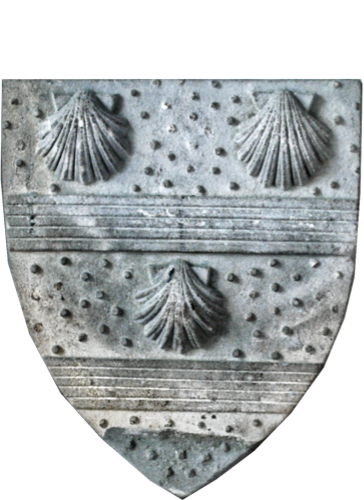
The ancient PARISH CHEST in the north-west comer is one of 32 Suffolk church chests which were imported (possibly from Poland) and may date from the 1300s. Made of pine, with a poplar lid, it was made to contain parish valuables and documents. It was equipped with three locks - the Rector and two Churchwardens each having a key, so that all three had to be present for it to be opened. The carved STONE SHIELD on the north wall nearby is of considerable age, and was probably once painted with a family's coat of arms.
The arch-braced ROOFS of the nave and chancel were made to Phipson's designs in 1874, as was the aisle's lean-to roof; there is no chancel arch, apart from the bold western arch-brace of the chancel roof. The SEATING arrived a few years earlier.
Light floods in through the clear glass of the windows, and only a few fragments of the 15th Century STAINED GLASS which once filled them survives at the tops of two north nave windows. The figures of the saints, etc. were destroyed by the Puritans in 1644, but perhaps they did not bother to reach the foliage designs high-up. The square PULPIT is a fine piece of 17th Century work, which would have been originally higher, as part of a three-decker arrangement.
Superb woodwork may also be seen in St James' unique LECTERN -this time from the 20th Century. It was designed in 1920 by Mary, wife of Sir Shafto Adair, and he carved the original massive owls, which were stolen in the 1980s, but the parish later had them skilfully and accurately replaced by John Gray of Chediston in 2002. The owls are not a matching pair, but each has its own character. The inspiration for the lectern's unusual design came from the Jacobean pulpit.
In the wall nearby is the ROOD LOFT STAIRCASE which gave access to the loft (or walkway) above the mediaeval rood screen, where candles burned in honour of the great rood crucifix above it. Money was left in 1517 for work on the loft ( and probably for these stairs, but in the 1540s all roods and their lofts were removed from churches by Law).
The medieval screen has also gone and the present CHANCEL SCREEN was made in 1920 in memory of those who suffered in World War I. This amazing piece of work by amateur villagers who attended evening classes organised by Sir Shafto Adair took almost a year to create without any professional involvement. Its trefoil- headed openings reflect those on the 14th Century screen-work at the west end of the aisle and the inscriptions on the east and west sides were carved by Sir Shafto.
Even more amazing work by these talented villagers may be seen in the carved PANELLING which lines the chancel walls, which was executed in 1921-22. It is enriched by a wealth of little carvings, where each woodcarver created simple carvings of subjects of their choosing. Hence we may enjoy an array of animals, birds, reptiles, flowers, etc., amongst the variety of religious emblems and symbols. This refreshingly amateur craftsmanship was encouraged and influenced by the Rector, the Rev' d Lancelot Bird. His obituary sates, 'whose wisdom and originality stimulated the village carving class to such excellent results'. Two brass plaques on the north side (by Philip Alexander of Walberswick), commemorate the nine parishioners whose lives were taken in World War 1, and other metal plaques commemorate clergy and parishioners, including a blacksmith and Parish Clerk, a teacher and a sexton. Many of these were made by Hiatt & Co of Great Barr, Birmingham, who also specialised in making police handcuffs!
Adorning the east wall is the striking REREDOS, given in memory of the Rev'd Townley Clarkson, who died in 1877. Flanking the east window aining the Creed, Ten Commandments and Lord's Prayer, whilst trefoil panels above the altar show wheat and vines for the Holy Communion, to be celebrated here 'Till He Come'.
The altar is a Stuart COMMUNION TABLE, where the Eucharist has been celebrated since the 1600s. In the tracery of the east window above are three roundels of late 19th Century stained glass, showing the chi-rho emblem (XP) which are the first two letters of 'Christ' in Greek, the six-pointed Star of David, and the nails and Crown of Thorns from Christ's Passion.
The sanctuary floor is paved with FLOOR TILES by Minton of Stoke on Trent, made to the designs of RM Phipson, displaying the pilgrim's staff and gourd, which are emblems of St James.
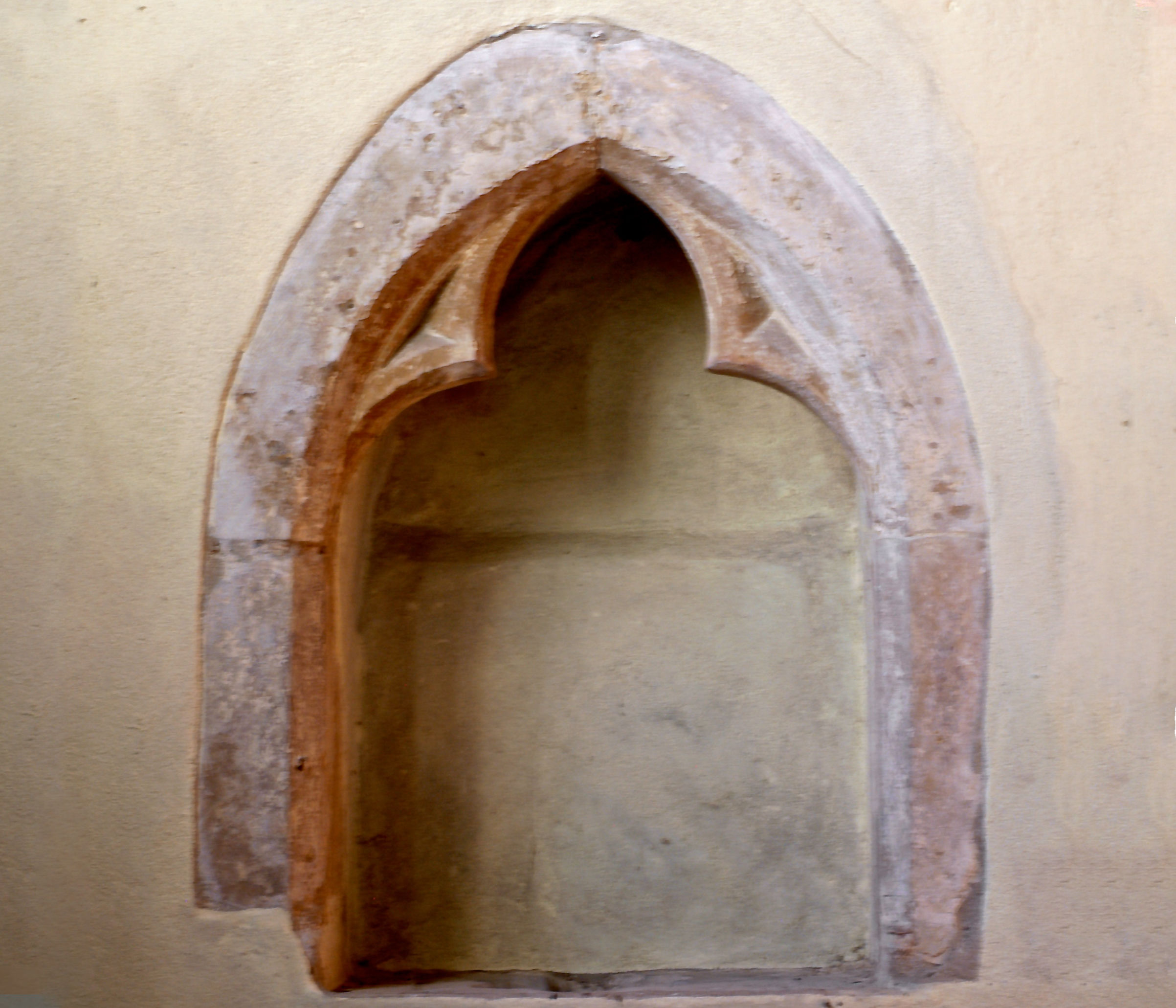
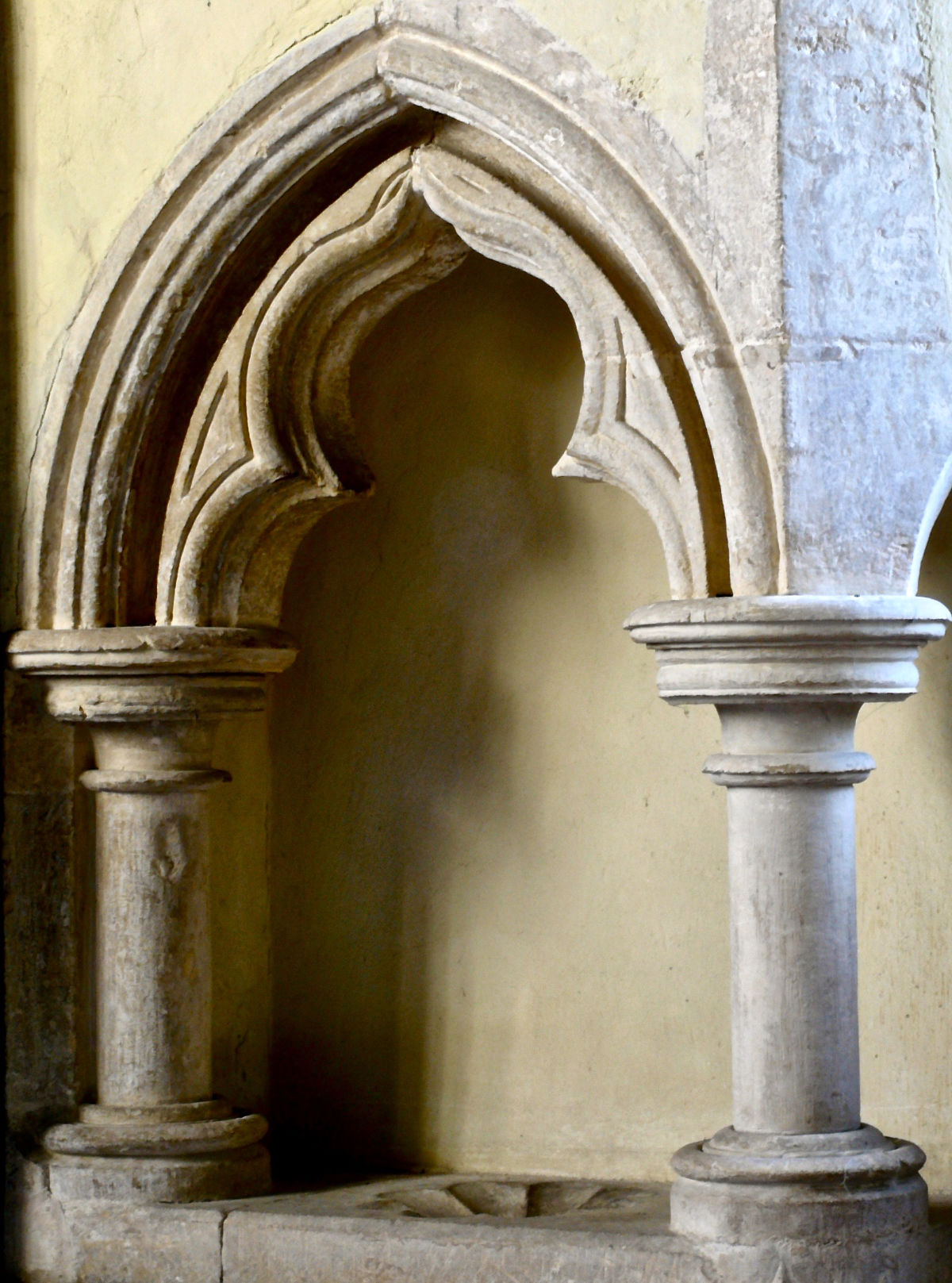
The amazingly well-preserved mediaeval STONE-CARVING OF ST JAMES above the priest's doorway shows his staff and, in his hat, his other emblem of the scallop shell, which is also depicted in the much later STONE SHIELD nearby. The south-east windowsill is lowered to form stepped SEDILIA, providing seating for the Celebrant, Deacon and Sub-deacon at the mediaeval High Mass. East of it is the PISCINA drain (beneath a beautifully-moulded arch of c.1320) into which disposable water from the Eucharist was poured.
There was a second altar at the east end of the south aisle, which was the CHAPEL OF ST JOHN THE BAPTIST, and was probably used by a parish Guild dedicated to him. It was removed by the Reformers in the 1540s and by 1924 was the long- established place for the church stove! Its ancient PISCINA however remains. During 1925-26, this chapel was restored to its former use and was equipped with a new altar (now in the vestry), backed by PANELLING made by the villagers. Its Latin inscription roughly means 'This was once the altar and was the abode of the Guild'. The Rector added a brass plaque commemorating the Revd Andrew Taylor, Rector for 38 years, who was buried here in 1474.
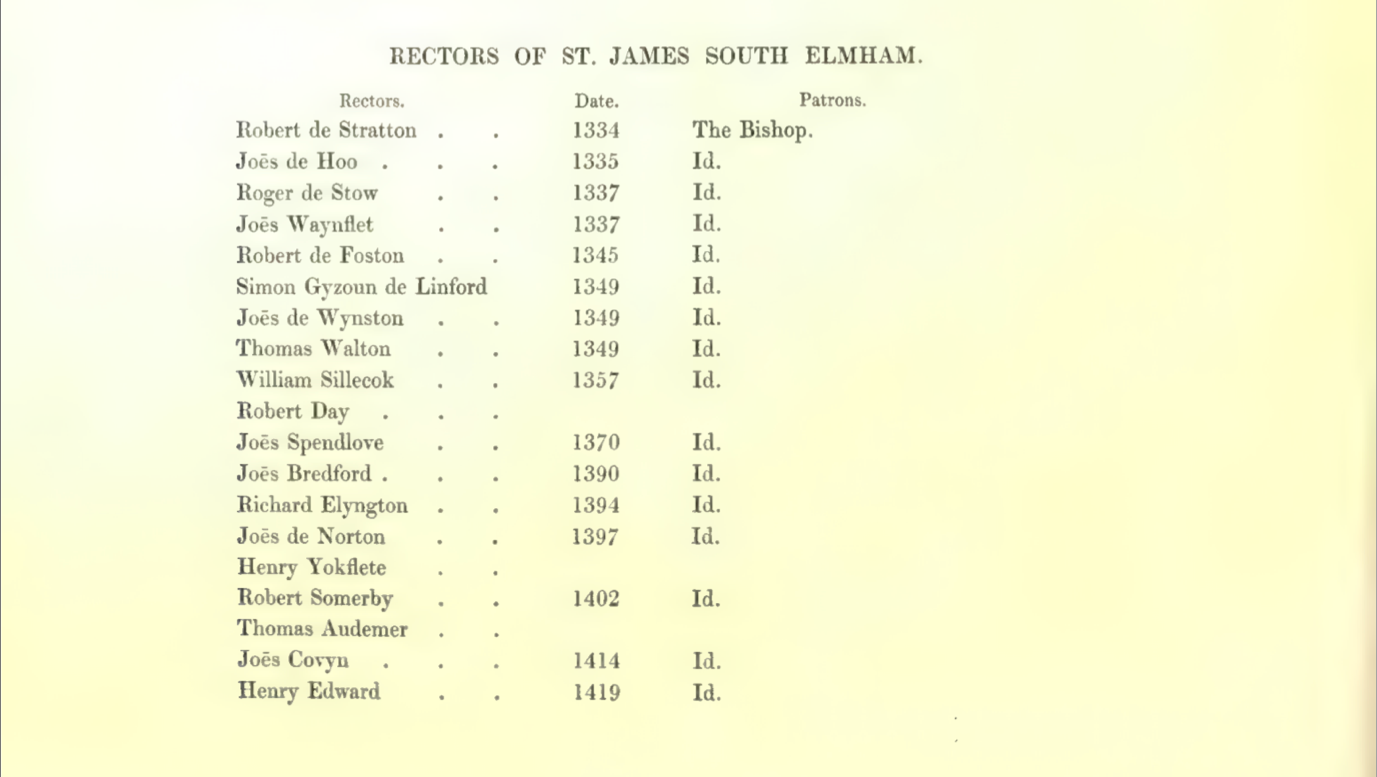
The 19th Century chamber ORGAN has a single manual and five speaking stops. It was though to have been in Ringsfield church until its was sold to a Methodist Chapel in 1890. In 1956 it arrived here, replacing a reed organ, and was given in memory of Reginald Pearce 'a generous benefactor of this church' .On the organ case hangs a LIST OF RECORDED RECTORS [View] from 1330, beautifully inscribed by AF Tilley. MEMORIAL SLABS in the floors of the church commemorate people of the past who were part of this church and parish.
Three are commemorated by BRASSES.
- Small mediaeval brass inscription to EDMUND HICBYTT SQUYRE. (Nave, north-west).
- Brass figures of a male and female in civilian costume of c.1500, with the indent for an inscription beneath them. (Nave Gangway).
- Brass inscription to WILLIAM GRUDGFIELD, who died in 1601 and bequeathed £10 for the Churchwardens to but five milk cows to be let out for 'the use of the poor of this parish for ever'. (Chancel)
Others are commemorated on LEDGER SLABS of black marble.
- JOHN GREENE, died 1685.
- THOMAS GREENE, DIED 1615.
- HANNAH GREEN (nee Aldrich, ofRumburgh). Widow of John, died 1712. (These are in the nave floor)
- THOMAS CRACKNELL (Churchwarden for many years, died 1865), his wife SARAH (died 1839), and their children, SARAH (died 1848, aged 23) and GEORGE (died 1834, aged 16). (Chancel, beneath the altar)
Most of the material in this section comes from the excellent monograph on St James Church South Elmham by Roy Tricker BEM (© Roy Tricker 2023). We are grateful for his kind permission to reproduce it here.