Village Church
What to See Inside the Church

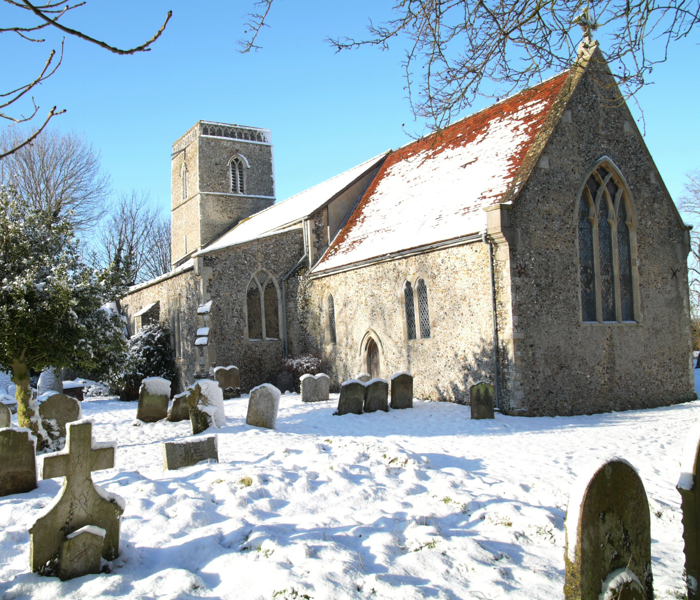
The interior of St James' is bright, cherished and cared-for, where the absence of stained glass admits plenty of light to illuminate a variety of craftsmanship from many periods.
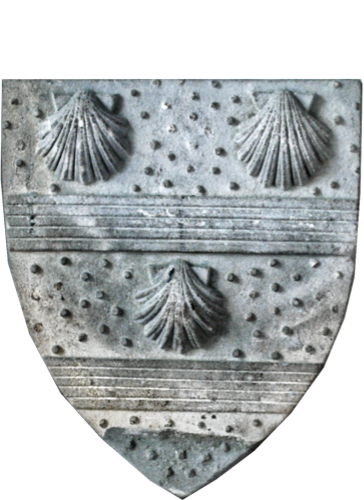
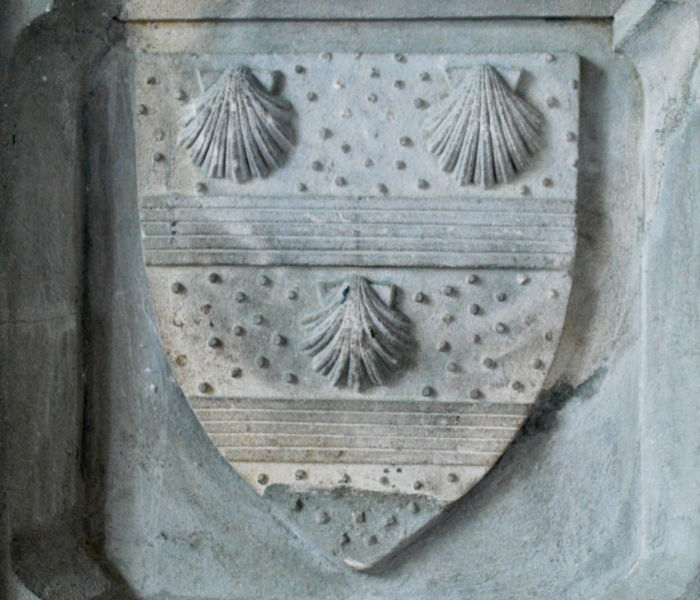
A 14th Century ARCADE of four bays divides the south aisle from the nave, although the western bay is wider and taller than the others, and may have been altered later, and Tudor brick has been revealed in its western respond. The SCALLOP SHELL above (the pilgrim emblem of St James) was bought thanks to a donation from his cathedral and shrine at Santiago de Compostela in Spain The wooden SCREEN-WORK at the entrance to the nearby vestry dates from the early 1300s and is thought to incorporate parts of a former rood or parclose screen. The former altar of St John's Chapel now serves as the vestry table.
On the nave's west wall, above the tower arch, hang the ROYAL ARMS of King George III. The two ROUND APERTURES flanking them in the wall are one of the church's mysteries. Some have suggested that they may even be blocked Saxon openings in use before the tower was built.
How Old is the Church?

The answer to this very sensible question is far from straightforward because St James, like all ancient churches, has gradually evolved over the centuries as people from different periods and Christian traditions have altered and beautified it and have left their mark upon it.
From what we can see in the building itself and from what little documentary evidence we have, some of the main landmarks in its long history are as follows:-
1100-1200 (or even earlier)
Because the Domesday Survey of 1086 treats the South
Elmham deanery parishes as a single settlement, we do not have a specific reference
to the existence of a church at St James, although one almost certainly existed here.
Some people have wondered if the circular recesses flanking the Royal Arms may
have been blocked windows in an original Saxon west wall.
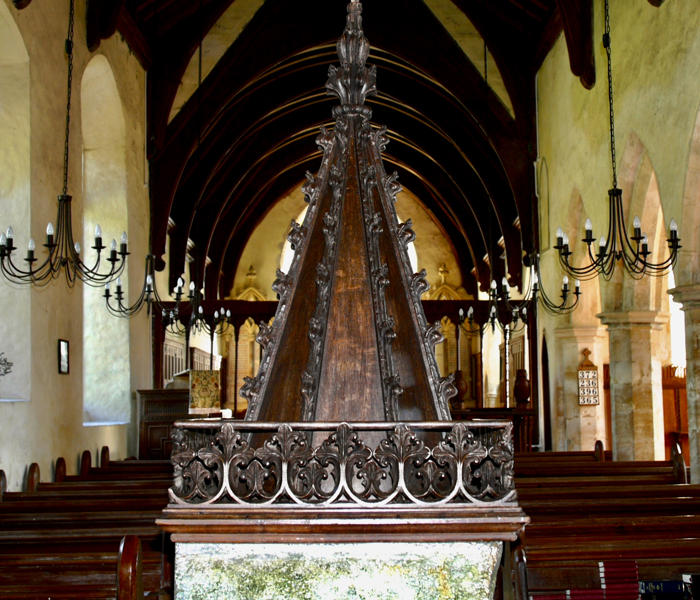
Much of the lower part of the north nave wall is faced with flints set in horizontal layers, indicating work of the 1 000s or 11 00s. The north doorway her incorporates billet-moulding- a feature ofNorman architecture, maybe of the 1100s, although the doorway itself may have been reconstructed, using this earlier work. The font, with its bowl of Purbeck marble also dates from the 1100s.
The 1200s and early 1300s
Much of the building we see today was constructed
during this period. The single Early English 'lancet' windows in the chancel date it
from the 1200s - the east window, with its intersecting tracery, completing it
c.1300. Also of c.1300 are the 'Y' tracery windows in the south aisle and the
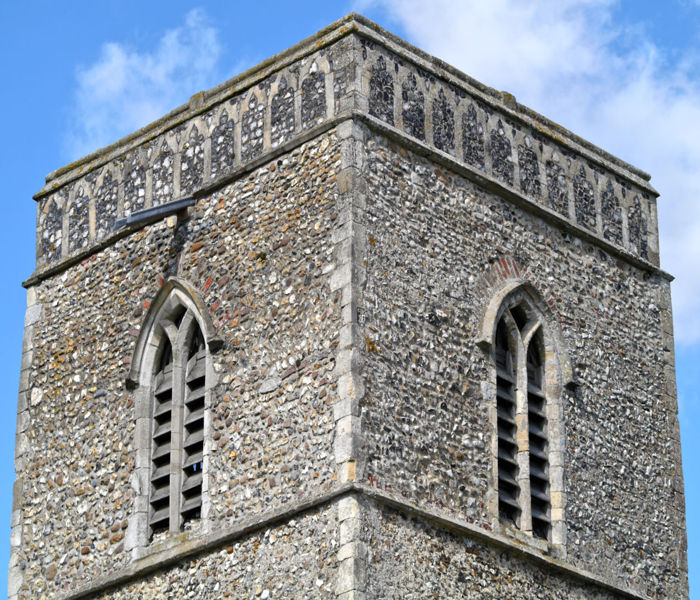
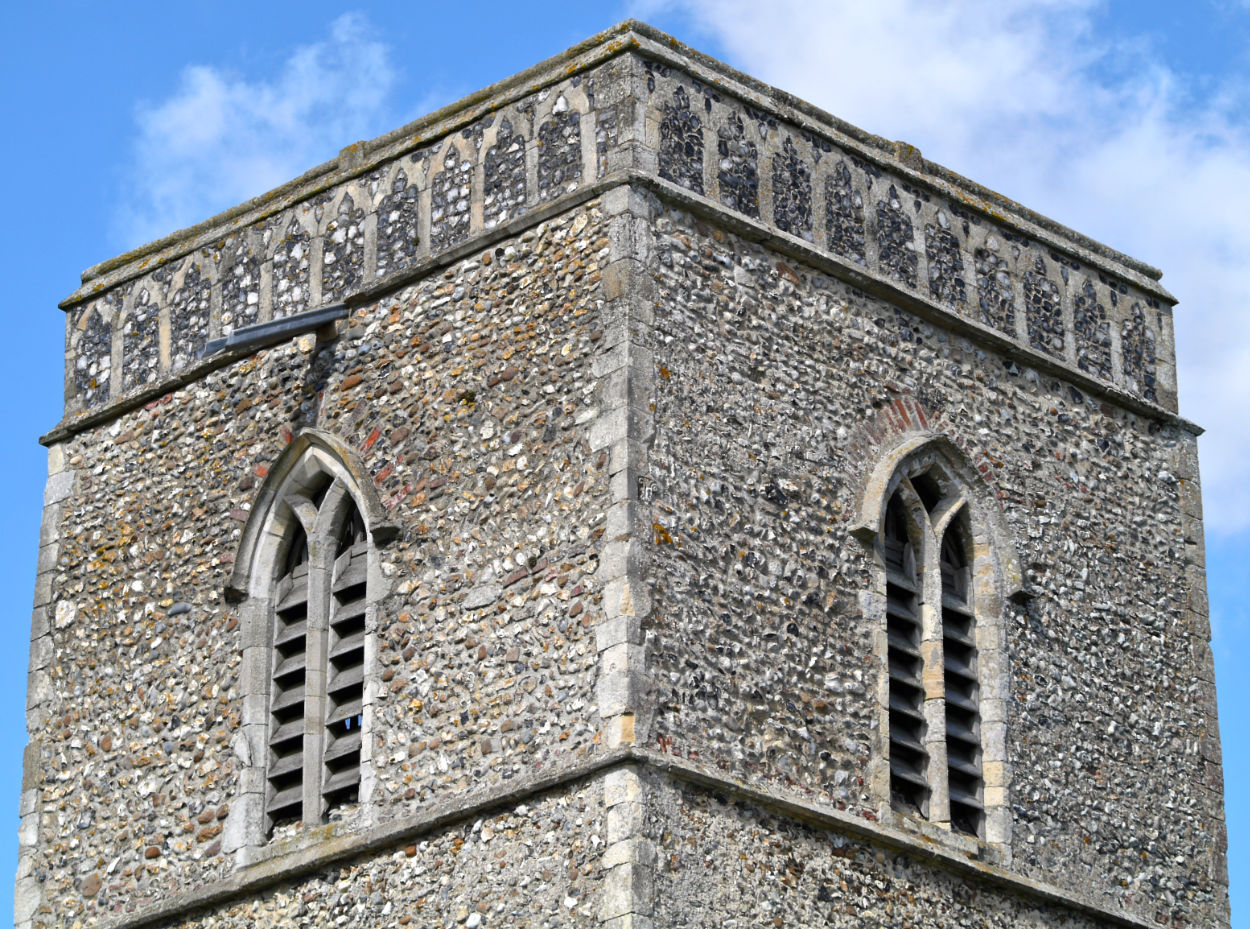
belfry windows, suggesting that the aisle and tower were added at his time. The vestry screen also
dates from this period and the Holy Water stoup arch is beautiful work of c.1330.
The 1400s and early 1500s -Alterations and improvements during the 1400s
included the two-light square-headed windows in the aisles and tower and the larger
and slightly later three-light window in the north nave wall. The font was adorned
with its splendid cover. A will of 1517 bequeathed 3s 4d towards the 'reparation' of
the rood-loft, which probably included the provision of the staircase to reach it.
The interior was by then a kaleidoscope of exquisite colour and carving - providing a
host of visual aids for the ordinary people who could not read nor understand the
Latin of the services and scriptures. All this was to change in the 1540s and 1550s,
when the interior was transformed to equip it for the 'reformed' worship of the
Church of England, by Law established.
The 1600s - c.1877
Further damage took place in 1644 at the hands of the Puritans,
in their zeal to rid our churches of what they called 'superstitious images and
inscriptions'. Although their Inspector, William Dowsing, did not record a visit to this
church, the parishioners almost certainly had a 'smashing time' here, for fear of a
visit by him. The few fragments of mediaeval glass in the nave's north windows
remind us of what once filled and adorned these windows.
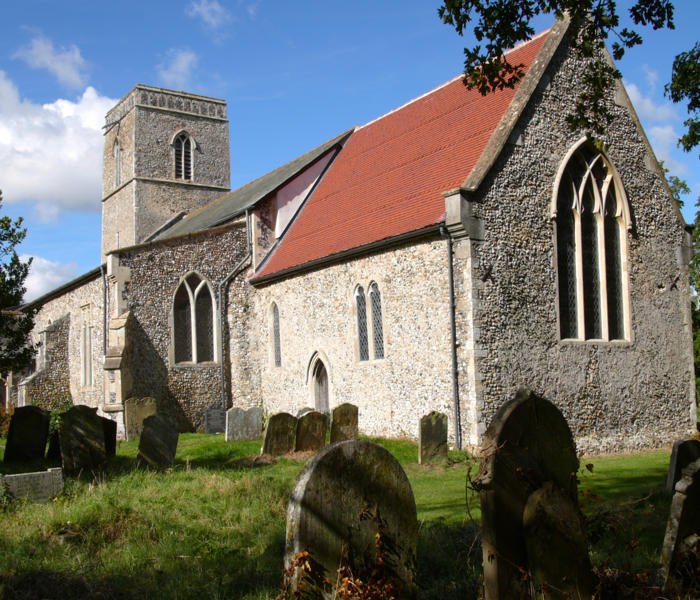
Little documentary evidence survives recording developments during this period although little seems to have changed in the fabric of the church. Isaac Johnson's sketch, published in 1818, shows the south side of the church looking much as it does today, but with a small window high up in the chancel wall. William Blois, visiting in the late 1600s, noted a coat of arms in glass (now gone) in one of the windows. David Elisha Davy of Ufford paid visits here in 1830 and 1849, and his notes tell us something of what the church was like before its major restoration. The nave and aisle roofs were covered with lead, whilst the chancel roof was tiled. Inside, the Communion Table was raised on two steps and enclosed in three-sided rails. On the wall above it were displayed the Lord's Prayer, Creed and Commandments. The pulpit was in its present position and the font stood against the western arcade pillar. The box-pews in the nave were described as 'very irregular and ordinary'. The west end of the aisle was divided off, and 'used as a lumber room'! The Religious Census, taken on 3ff11 arch 1851, recorded that the church contained accommodation for 70 in rented pews and 120 in 'free sittings'. The congregation in the morning was 65 adults and 12 scholars, whilst 150 adults and 29 scholars attended the afternoon service. The Holy Communion was celebrated four times per year for about 15 communicants. The population of 269 included one Baptist family. Wednesday November 4th 1874 was a great day for St James' parish, when their newly-restored church was re-opened at a great service at which the Dean of Norwich preached. The church, like many others, had become very decayed and neglected and the Rector, the Revd Townley Clarkson, decided to replace the rotten chancel roof with 'a roof of massive and elegant proportions', to restore the east gable and crown it with a cross, and to provide his chancel with a floor ofMinton's tiles. This prompted the parishioners to carry out a thorough restoration of the nave, aisle and porch. The windows and doorways were restored, new roofs were provided, the fabric repaired, and the interior re-plastered.
The work was carried out by Messrs Ludkin & Son of Banham, to the designs of Richard Makilwaine Phipson, the Diocesan Architect, who was also restoring nearby St Margaret's church. He designed a new rectory here, also St Margaret's school, and rectory extensions at Homersfield and St Cross. His work may be seen in several Suffolk churches, including the Civic Church of St Mary le Tower Ipswich, and Great Finborough, which he rebuilt, and St John's Church Harleston, which he designed. In memory of the restoring Rector, Townley Clarkson (who died in August 1877). his widow, Eleanor, gave the reredos which adorns the east wall.

The 20th Century
The early years of this century saw the church beautified in
a way which makes its interior unusual and special, thanks to the Patron of the
living, Sir Shafto Adair, of Flixton Hall, who organised evening classes where
villagers of all ages were taught the skills of carpentry and woodcarving. The
results of their skills may be seen adorning the chancel and elsewhere in the
church. This work had the enthusiastic support and backing of the Rector, the
Revd Lancelot Bird.
After the 1914-18 War, work began on the parish's remarkable War memorial- the chancel screen, fashioned, without professional help, by the villagers in oak given by Sir Shafto from his Flixton estate. It took almost a year to construct. A brass plaque recording the names of the Fallen, made by Philip Alexander of Walberswick, was placed in the chancel. After their dedication on l " July 1920 by the Revd Hawtrey Enraght of Holy Trinity Bungay, a bugler from Bungay Grammar School sounded the General Salute.
At this time the old pitch-pine lectern was replaced by the handsome oak lectern (believed to have been created by Lady Adair), with its two owls, which were carved by Sir Shafto himself.The pair of double windows may date from c.1400, whilst the elegant three-light window arrived later in the 15th Century.
The small single 'lancet' windows in its north and south walls date the CHANCEL to the 1200s, its three-light east window, south-east window and priest's doorway being added c.1300. In the stonework on the south side of the priest's doorway are faint traces of a MASS DIAL, which enabled that priest to calculate the start of services before the days of clocks.
The SOUTH AISLE is lit by two 'Y' traceried windows of c.1300 and two square- headed Perpendicular windows of c.1400.
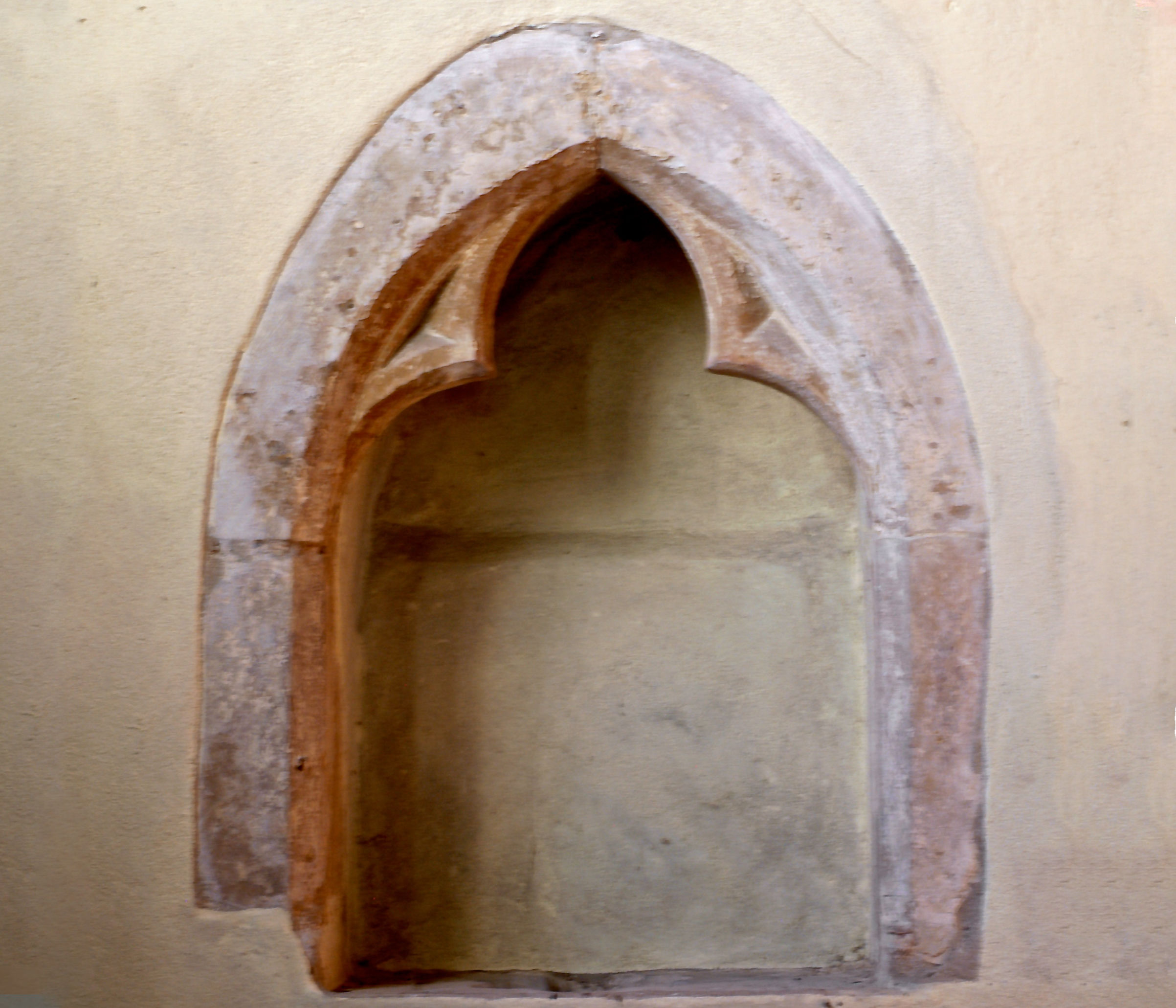
The SOUTH PORCH, by which we enter needed much restoration in 1874, when its outer entrance arch and windows were renewed. The 14th Century inner entrance arch however is original. It contains an exquisitely-carved door, made in the village in 1924 in memory of Alfred and Sarah Cunningham of nearby Church Farm. The Holy Water stoup nearby is set beneath a graceful trefoil-headed arch, embellished with leaf-crockets and crowned with a finial. Here mediaeval worshippers dipped their fingers in Holy Water and made the Sign of the Cross as an act of symbolic cleansing and rededication upon entering the sacred building.
Most of the material in this section comes from the excellent monograph on St James Church South Elmham by Roy Tricker BEM (© Roy Tricker 2023). We are grateful for his kind permission to reproduce it here.